BI4ALL BI4ALL
  • Expertise
    • Artificial Intelligence
    • Data Strategy & Governance
    • Data Visualisation
    • Low Code & Automation
    • Modern BI & Big Data
    • R&D Software Engineering
    • PMO, BA & UX/ UI Design
  • Knowledge Centre
    • Blog
    • Industry
    • Customer Success
    • Tech Talks
  • About Us
    • Board
    • History
    • Partners
    • Sustainability
    • Awards
    • Media Centre
  • Careers
  • Contacts
English
Português
Last Page:
    Knowledge Center
  • Optimising Performance in Microsoft Fabric Without Exceeding Capacity Limits

Optimising Performance in Microsoft Fabric Without Exceeding Capacity Limits

Página Anterior: Blog
  • Knowledge Center
  • Blog
  • Fabric: nova plataforma de análise de dados
1 Junho 2023

Fabric: nova plataforma de análise de dados

Placeholder Image Alt
  • Knowledge Centre
  • Optimising Performance in Microsoft Fabric Without Exceeding Capacity Limits
12 September 2025

Optimising Performance in Microsoft Fabric Without Exceeding Capacity Limits

Optimising Performance in Microsoft Fabric Without Exceeding Capacity Limits

Microsoft Fabric is a powerful, unified analytics platform, but even the best engines can overheat if pushed too far. Fabric capacities come with defined compute and memory resources, and hitting its usage limits can stall workloads, degrade performance, or stop working completely when going beyond the limits.

The good news? Fabric offers multiple levers for optimising performance while keeping workloads within safe boundaries. Below are some practical strategies, their benefits, and their trade-offs.


1. Explicit Parallelism Limits

Fabric’s compute services, such as Data Pipelines and Notebook Sessions, allow you to control the number of concurrent operations or threads. By capping parallelism, you prevent one workload from hogging resources and causing throttling.

For example, you might set a limit on the number of iterations to run in parallel when copying multiple objects from a source on the pipeline, or limit the number of Spark DAGs to run in parallel.

Pros:

  • Prevents sudden capacity unit spikes that could breach capacity limits.
  • Improves predictability in multi-user environments.
  • Simple to configure and enforce at service level.

Cons:

  • Completion takes longer than necessary if limits are set too low.
  • Requires ongoing tuning as workloads evolve.
  • Doesn’t account for ad hoc workloads run by users.


2. Using Multiple Capacities for Different Workloads

Fabric lets you provision multiple capacities (e.g., F64, F128, etc.) and assign different workloads to them. For example, critical dashboards could live on one capacity while experimental notebooks run on another for clearer management of capacity units spent.

Pros:

  • Isolates workloads to prevent issues when using multiple compute services throughout the day.
  • Allows differentiated performance SLAs for different teams or projects.
  • Easier to scale or pause a single capacity without affecting others.

Cons:

  • Additional licensing cost for each capacity.
  • Requires governance to ensure workloads are assigned correctly.
  • May lead to underutilization if capacities are poorly balanced.


3. Increasing the SKU Dynamically According to Demand

You can scale up your Fabric capacity SKU temporarily (e.g., from F64 to F128) during peak workloads and scale back down when demand drops. This allows you to use Fabric for that extended usage period while controlling the costs for that expected spike.

Pros:

  • Immediate access to more capacity units during spikes, allowing you to run more jobs and/or handle more complex workloads.
  • You pay for higher capacity only when needed.
  • No need to restructure workloads.
  • Potential for automated scaling via Fabric Web APIs.

Cons:

  • Potential for cost overruns if scaling periods are too long.
  • Scaling up can mask inefficient queries or pipelines that should be optimised.


4. Optimising Workload Scheduling

By staggering jobs (especially heavy ETL processes, ML training runs, or large dataset refreshes), you can avoid peak-time contention. Fabric’s orchestration tools and scheduling features in Data Pipelines and Notebooks help here. To name a few options, you can schedule pipeline, notebook jobs, and semantic model refreshes to run at suitable and control the workloads.

Pros:

  • Smooth resource usage over time.
  • Reduces the risk of hitting throttling or eviction thresholds.

Cons:

  • Requires scheduling governance.
  • May increase latency for dependent tasks.
  • Can be undermined by ad-hoc queries or unscheduled jobs.


5. Monitoring and Alerting on Capacity Metrics

Fabric provides capacity metrics in the admin portal and APIs. Setting up alerts (via Azure Monitor or Power BI integration) allows you to react before limits are hit. You can even leverage Real-Time Intelligence within Fabric to act on the latest events in real-time.

Pros:

  • Early warning system to prevent service degradation.
  • Supports data-driven decision-making for scaling or optimisation.
  • Enables historical analysis to spot patterns.
  • Switch from reactive to proactive decision-making about your capacity management.

Cons:

  • Monitoring alone doesn’t solve performance problems — action is still needed.
  • Requires time to configure and maintain alert rules.
  • Too many alerts can lead to noise fatigue.


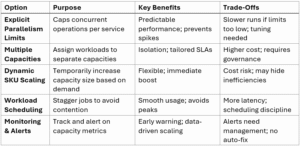
Summary: Microsoft Fabric Performance Optimisation Options


Final Thoughts

Microsoft Fabric provides flexibility in balancing performance and capacity limits. However, there’s no one-size-fits-all answer.

Most organisations benefit from a layered approach: use monitoring to act proactively, enforce parallelism limits for predictable performance, and scale up or isolate workloads only when justified by the data.

Smart governance and a culture of proactive optimisation will do more for performance than any single setting. In other words: Fabric gives you the knobs; it’s up to you to turn them wisely.


Author

José Fernando Costa

José Fernando Costa

Senior Consultant

Share

Suggested Content

Vision 2026: The complete overview of AI Trends eBooks

Vision 2026: The complete overview of AI Trends

This eBook brings together the key trends that will shape 2026, including intelligent agents, invisible AI, and physics.

The Role of Data Governance in Building a Data-Enabled Organisation Blog

The Role of Data Governance in Building a Data-Enabled Organisation

Data governance is the backbone of a truly data-enabled organisation, turning data into a trusted, secure, and strategic asset that accelerates insight and innovation.

Enable Digital Transformation through Data Democratisation Use Cases

Enable Digital Transformation through Data Democratisation

The creation of a decentralised, domain-oriented data architecture has democratised access and improved data quality and governance.

The Data Catalogue: Turning Governance into a Strategic Control Plane Blog

The Data Catalogue: Turning Governance into a Strategic Control Plane

The Data Catalogue transforms Data Governance into a strategic, automated system that connects people, data, and policies to build lasting trust and value.

Strengthening Competitiveness Through Data Strategy and Governance Use Cases

Strengthening Competitiveness Through Data Strategy and Governance

The definition and implementation of a data governance strategy and model enabled data to be aligned with business objectives, ensuring compliance and increasing efficiency and competitiveness.

Enterprise Data Maturity Assessment (DMA) for a Multinational in the Manufacturing Sector Use Cases

Enterprise Data Maturity Assessment (DMA) for a Multinational in the Manufacturing Sector

A decentralised manufacturing multinational implemented a tailored Data Maturity Assessment to align independent entities under a unified data strategy and framework.

video title

Lets Start

Got a question? Want to start a new project?
Contact us

Menu

  • Expertise
  • Knowledge Centre
  • About Us
  • Careers
  • Contacts

Newsletter

Keep up to date and drive success with innovation
Newsletter
PRR - Plano de Recuperação e Resiliência. Financiado pela União Europeia - NextGenerationEU

2026 All rights reserved

Privacy and Data Protection Policy Information Security Policy
URS - ISO 27001
URS - ISO 27701
Cookies Settings

BI4ALL may use cookies to memorise your login data, collect statistics to optimise the functionality of the website and to carry out marketing actions based on your interests.
You can customise the cookies used in .

Cookies options

These cookies are essential to provide services available on our website and to enable you to use certain features on our website. Without these cookies, we cannot provide certain services on our website.

These cookies are used to provide a more personalised experience on our website and to remember the choices you make when using our website.

These cookies are used to recognise visitors when they return to our website. This enables us to personalise the content of the website for you, greet you by name and remember your preferences (for example, your choice of language or region).

These cookies are used to protect the security of our website and your data. This includes cookies that are used to enable you to log into secure areas of our website.

These cookies are used to collect information to analyse traffic on our website and understand how visitors are using our website. For example, these cookies can measure factors such as time spent on the website or pages visited, which will allow us to understand how we can improve our website for users. The information collected through these measurement and performance cookies does not identify any individual visitor.

These cookies are used to deliver advertisements that are more relevant to you and your interests. They are also used to limit the number of times you see an advertisement and to help measure the effectiveness of an advertising campaign. They may be placed by us or by third parties with our permission. They remember that you have visited a website and this information is shared with other organisations, such as advertisers.

Política de Privacidade